A friend forwarded this article criticizing Merrick Garland’s views on equity.
Here’s an image people like to use to show why equity is fairer than equality.
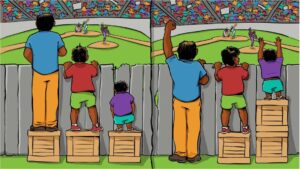
Treating everyone “equally” doesn’t work in this situation, since people have different needs. And this is exactly what you would do if you were that dad.
(By the way, why isn’t this image criticized as racist, since it seems to imply that these brown-skinned people can’t afford tickets to the game?)
This is clearly the way we should treat individuals. E.g., Joe doesn’t need any help, so he doesn’t get any. Sam needs a little help, and Ezra needs a lot.
Well and good. The problem is when you start assigning the amount of help that is due based on something other than the amount of help that is needed. If you say, for example, that white people don’t need any help, but all black people do, that’s simply ridiculous. There are plenty of poor white people and rich black people.
The problem with all this “diversity, equity and inclusion” stuff is that it’s not based on individual needs. It’s based on identity politics and group characteristics, and that makes it both racist and foolish.
Exactly. We run our homes like communists. “From each according to his abilities to each according to his needs”. But that doesn’t mean it works for society. Identity politics is collectivism where the individual doesn’t count.
I think the challenge is that the rules for whether it makes sense to give everyone a different-sized box to stand on, or the analogous contribution to bring about equality of results, can’t be formalized.
Even in the example in the picture, why are the viewers having to stand on boxes, and not be inside? If they can’t afford good tickets, shouldn’t they be subsidized, so they have as good a view as anyone else?
In fact, why shouldn’t they be playing in the game itself? Sure, they might not have as much natural talent as other people, but that’s not their fault, any more than it’s the fault of the youngest that he’s not tall enough to see the game except on the largest box. This can be corrected in-game by requiring pitchers to adjust their speeds, by giving more swings to different players based on their abilities, etc., etc.
And next thing you know you’re in a Harrison Bergeron dystopia.
My mother surprised me once by telling me there was a science fiction short story she really liked. It was Harrison Bergeron. 🙂
The basic claim of the “equity” people is that everyone has different needs, so it doesn’t make sense to give them all “equal” help. I agree.
For example, let’s say some neighborhood has a very high rate of diabetes, but nobody in that neighborhood is getting the treatment they need. It might be “equitable” to have some special outreach to that neighborhood and give them the help they need.
Okay.
Two questions that immediately arise are (1) as you point out, how far do you take this desire to have equal outcomes, and (2) how do you identify which people need what help?
The left wants to marry “equity” with identity politics and treat people according to those groupings. So first we organize people by their skin tone and who they fancy sexually, then within those groups we look for “inequities” — unequal outcomes. We find that people who fancy walruses tend to have a higher rate of poverty than other people, so we start sending money to all the walrus fanciers. Never mind that some walrus fanciers are richer than Midas — it’s the group that matters.
You know, I’ve probably seen that graphic a half a dozen times before now and it didn’t occur to me until DSM’s comment that whoever made that thing chose to use a situation where people are presumed to be entitled to see a paid public event without paying for it, and that there’s a fundamental unfairness if they don’t all receive sufficient community assistance to enable them all to see it equally well.
That’s such a weird situation to pick — they didn’t use a public parade, or a situation where someone was trying to meet a genuine need, they were presuming entitlement to an entertainment that other people had to pay for.
I’m not sure what it says about the mindset that created the graphic, but it says something, I’m pretty sure.
“We find that people who fancy walruses tend to have a higher rate of poverty than other people, so we start sending money to all the walrus fanciers. Never mind that some walrus fanciers are richer than Midas — it’s the group that matters.”
This is the classic “why should working class white people pay reparations to Will Smith?” issue. It’s so messed up.