How about the people who have threatened the judge and jury in the Rittenhouse case if they don’t reach the verdict they want?
Fair trials in the public view?
I haven’t followed the Rittenhouse story very much. It doesn’t particularly interest me. My casual opinion is that Rittenhouse was stupid to get involved the way he did, but that the shootings were in self defense. He’s probably liable for other charges.
But that’s not my point here. The bigger issue, IMO, is how the legal system can work when a trial “goes viral,” as they say.
The judge has been threatened. Jurors are afraid that if they come to the “wrong” verdict, there will be riots, and they might be attacked personally.
I don’t know how we solve this. We don’t want secret juries. We don’t want to tell the press what they can and can’t cover. But it’s also quite clear that these sorts of cases come with serious risk of an injustice being done because of the public attention.
It’s not just the basket of deplorable Trump supporters who are resisting the vaccines
It’s a world-wide problem.
Covid-19 Vaccine Hesitancy Is Worse In E.U. Than U.S.
Austria introduces lockdown for unvaccinated. About 65% of Austrians have been vaccinated.
“Only 36% of surveyed Europeans strongly agree with the statement that vaccines are safe.”
Poll after poll conducted across Europe suggest very large numbers of Europeans have serious qualms about the safety of vaccines and potential short- and long-term adverse effects. They also voice concern about the speed with which vaccines went through the clinical development process. A vocal minority perceives the vaccine as unnecessary. And many have conveyed their mistrust of global and national authorities as well as pharmaceutical companies, who some regard as solely pursuing financial interests and not those of public health.
There are a lot of possible explanations for vaccine hesitancy. Stupid junk on the internet is certainly one factor, and a generalized distrust of authority is another.
I’m convinced people wouldn’t be as susceptible to internet nonsense if the public health authorities were more open and transparent.
Thank God the president can’t make laws
When I hear about COP26, my main consolation is that the president can’t commit the U.S. to something without the approval of Congress. That is, if our system operates properly, which it hasn’t been doing recently. Obama was able to commit us to some climate nonsense, which Trump was able to undo. That’s not how it’s supposed to work.
With the Senate evenly divided, I’m hoping they will be able to prevent Biden from sleepwalking us into some bad policies.
BTW, can anyone remember how many decades it’s been that the world only has a decade to get greenhouse gases under control? I’m thinking it’s at least three.
COP26 is at least partially right. We should phase out fossil fuels, but we should replace them with energy that works. That means nukes.
An idea for easing the problem of gerrymandering
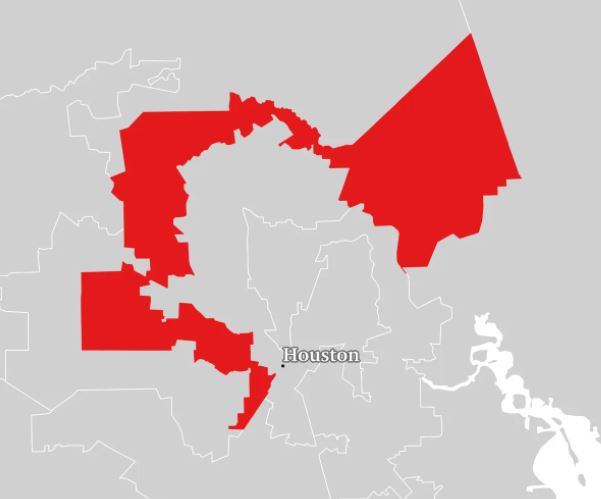 The shape of some Congressional districts seems ridiculous, and people have been talking for a long time about how to solve this.
What if we took geography out of the equation?
Rather than voting for a Congressman who will represent the people who live in a certain area, why not pick Congressmen who will represent a political position?
Here’s how it would work. Anyone can write a party platform. If they get more than some threshold number of people to sign on, they get on the ballot. People then vote for a party — i.e., for an idea.
The party would disclose the people they would appoint to office if they win. For example, if you were some small party, you might only have a chance of getting five people in office, but you might only get one. So you’d list the people you would appoint, in order.
The assumption would be that policy is more important than geography, although people could start parties that represent geographical concerns. One side benefit of this concept is that it would severely curtail the power of the two-party system.
This would not a parliamentary system, because the people would still vote for Senators and for the President. (Although I would also like to go back to having states appoint Senators, but that’s a different issue.)
It’s a rough idea, and would need some work, but what do you think of the general concept?